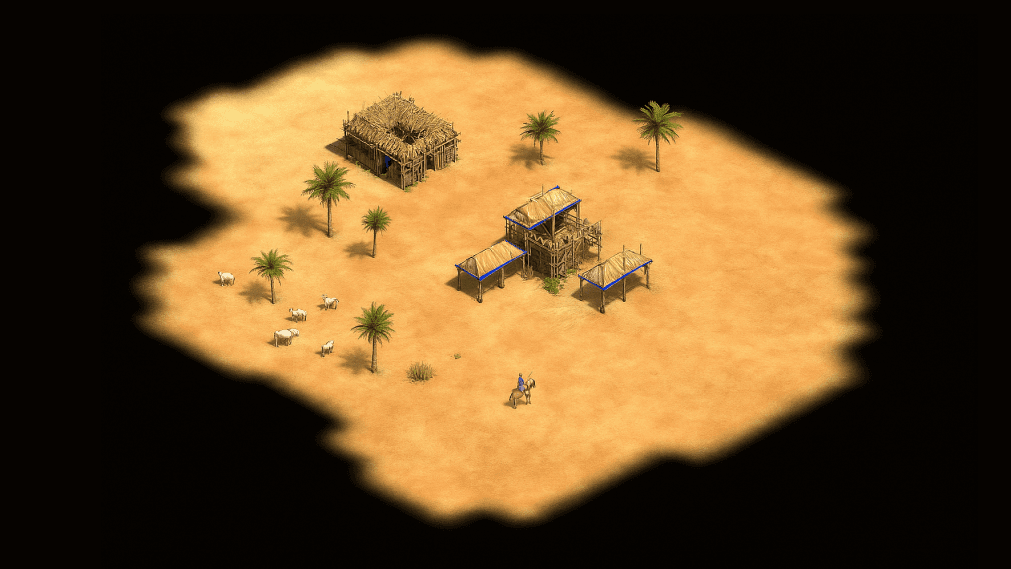
I like playing Age of Empires, although I have to confess something: I’m one of those slightly campy players. I stay in the village slaughtering sheep, building walls, and trying to have everything nicely organized before heading out to explore. I struggle to send out the little horse at the beginning (people keep telling me it’s called a scout, no idea). It gives me a mix of anxiety and a need to control everything from a safe place.
But the game doesn’t move forward if you don’t go out. The map starts completely black, and you can only see what’s right around you. To get to know the world, you have to move. Every step reveals a bit more. And slowly, what used to be darkness begins to show paths, resources, threats, and opportunities.
That image works as a powerful analogy for something I see often in teams: hidden talent.
There are people with enormous potential who are, nonetheless, stuck in their initial quadrant. Not because they lack talent. Not because they don’t want to grow. But because the map around them is still dark. And no one, neither they nor their leaders, is walking toward those edges to see what else is out there.
Sometimes that talent doesn’t show up because people don’t see it in themselves. Other times, because the environment doesn’t allow it to unfold. The truth is, there are many reasons why someone with a lot to give isn’t shining. And if we don’t understand those reasons, it’s very easy for the map to remain stuck.
Personal barriers: fear, doubt, and a fixed mindset
Some people believe their abilities are innate and unchangeable. So if they feel they’re not good at something right away, they don’t even try. They avoid mistakes because they think mistakes define them. That perspective, known as a fixed mindset, traps people in a safe but limited zone.
On top of that comes fear of failure, impostor syndrome, lack of confidence. All of that creates a kind of internal fog, a darkness that prevents them from going out to explore. They prefer to stay in the area they know, doing what they already do well, but without pushing themselves further.
Organizational barriers: how culture and leadership can keep the map hidden
On the other side is context. Many times, people want to expand, but the system won’t let them. Processes are rigid. Leaders are more focused on what’s urgent than on what’s possible. The culture rewards those who don’t make mistakes, not those who try. And so, any kind of exploration becomes risky.
In these environments, even well-intentioned attempts to go further can be seen as a threat to the status quo. Predictable execution is valued more than curiosity, and strict compliance more than proposing something new. This creates a kind of organizational inertia where people end up adapting to not standing out, not taking risks, keeping their ideas within known boundaries. The implicit message is clear: “don’t leave your quadrant.” And so the map stays dark, both because of a lack of explorers and an excess of structures that discourage exploration.
It also happens that companies, by relying on overly narrow or traditional criteria to evaluate talent, end up filtering out people with great potential. If we don’t take the time to look beyond the obvious, beyond the title, the background, the communication style, we miss gold. Very often, the most transformative potential lives in those who haven’t yet had the chance to show everything they’re capable of.
The role of leadership: multiplying, not absorbing
There’s a key concept in the book Multipliers: How the Best Leaders Make Everyone Smarter: some leaders act like talent magnets, they attract it, recognize it, and amplify it. And there are others who dim it. Not because they’re bad, but because they don’t know how to create the conditions for others to expand.
A good leader doesn’t settle for what’s already visible. They suspect there’s more. They don’t stop at the surface version of their team, but go looking for that 80% that’s still in the shadows. They push, challenge, ask questions, and support. They create psychological safety, but also challenge. They don’t solve the map for you, but they make you want to explore it.
Exploring the map is also about expanding awareness
When someone starts to see more of the context, they begin to operate from a different place. They better understand how their work impacts others. They anticipate. They propose. They make decisions with judgment. They no longer act only as executors, but as people who interpret the system, connect dots, and contribute from a more strategic perspective. That expansion isn’t just professional, it’s also personal. It’s starting to see yourself as someone with more possibilities.
What’s interesting is that this new awareness also feeds further growth. When someone sees more, they want more. They become more curious, more restless, more proactive. But that doesn’t come out of nowhere, it needs the right conditions. Google, for example, had the famous “20% time policy”: one day a week where you could work on whatever you wanted. That’s where things like Gmail and Google Maps came from. Because exploration was allowed. Because there was trust that there was more to be shown. Because it was understood that potential needs space, not just direction.
And this is where leadership becomes crucial. Because it’s not enough for someone to have potential, someone else has to see it, encourage it, and challenge it. It takes a perspective that enables. An environment that invites exploration. A map that isn’t only walked alone, but also together.
Leading is exploring with others. It’s having the courage to step into what isn’t visible yet. It’s trusting that, if we open up the map, we’ll find resources, strengths, ideas, and people who are waiting for a chance to reveal themselves.
And if you’re reading this and you’re one of those who stays gathering berries until halfway through the game, I get it, I’ve been there too. But come on, step outside, there’s a whole world out there to explore and nothing bad is going to happen. You’re going to crush it, trust me.
Do you feel like you’re stuck in your own little plot of land and find it hard to step out? Have you been there and managed to break free? Tell me in the comments :)